

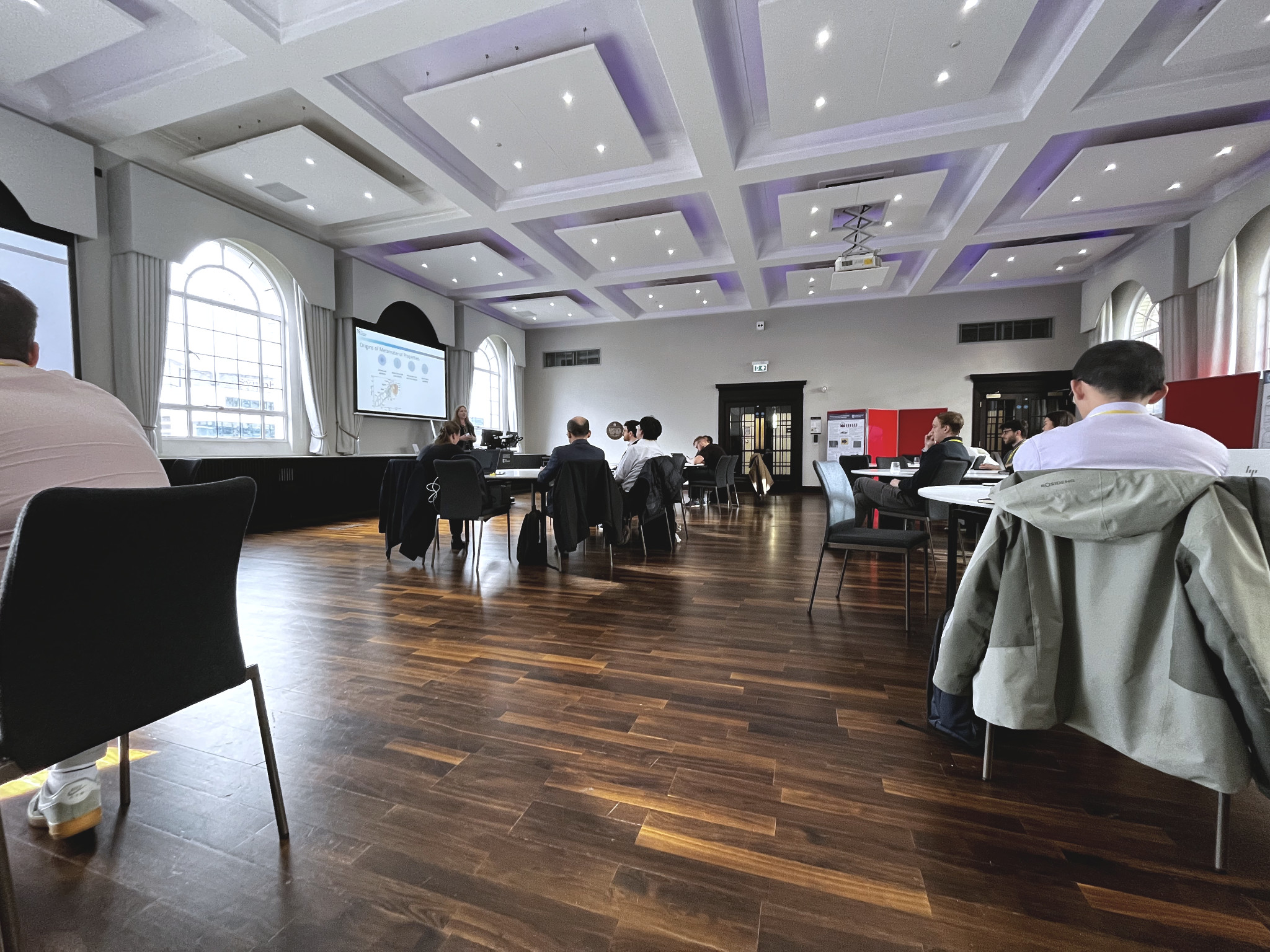

Earlier this week, the MaxLLG team joined researchers and industrialists from across the UK at The Exchange in Birmingham for the inaugural Metamaterials Manufacturing Conference, organised by the UK Metamaterials Network. It was a focused, candid, and energising two days. An that left us with a clearer sense of both the scale of the challenge ahead and the community’s readiness to meet it.
The conference brought together academics working on fabrication and design, materials scientists, metrologists, and industry representatives. The scientific principles underpinning metamaterials are increasingly well established. The frontier has shifted — to manufacturing: making these structures consistently, reliably, and at scale. What was notable about this gathering was the directness with which that challenge was confronted.
One theme that surfaced repeatedly, and with some urgency, was the question of who leads on manufacturing. There was a broad sense in the room that the metamaterials community cannot afford to wait for established industry to find its way to these materials. If metamaterials are to reach their potential — in telecommunications, defence, aerospace, and beyond — researchers and specialist companies need to take ownership of the manufacturing challenge themselves, developing the methods, the standards, and the supply chains that will make commercialisation possible.
Closely related was the challenge of scale — in two distinct senses. First, scaling the materials themselves: fabrication techniques that work at the millimetre scale must be made to work across larger areas and more complex geometries. Second, scaling production volume: moving from prototype to repeatable manufacture without sacrificing the structural precision on which metamaterial performance depends. Both demand advances not only in manufacturing methods but in computational modelling. Simulation tools capable of handling larger, more complex structures — and doing so at speed — are not a downstream concern; they are part of the manufacturing solution. It was gratifying to see that framing taken seriously across the conference.
A thread woven through many discussions was the need for resource sovereignty, and in particular a sustainable, secure supply of rare earth elements. For magnetic metamaterials especially, dependence on constrained global supply chains is a genuine strategic vulnerability. The community is beginning to grapple with this seriously — both in terms of material substitution research and in designing devices that use critical materials more efficiently.
MaxLLG contributed to the conference with a poster presenting our ML-powered inverse design tool, which uses machine learning trained on our high-fidelity simulation data to dramatically accelerate the design of magnetic metamaterials. Rather than iterating through candidate geometries by trial and error, the system infers the structure required to achieve a target electromagnetic response — orders of magnitude faster than conventional approaches. In a manufacturing context, where design-to-fabrication cycles need to be as tight as possible, that kind of acceleration has direct practical value.
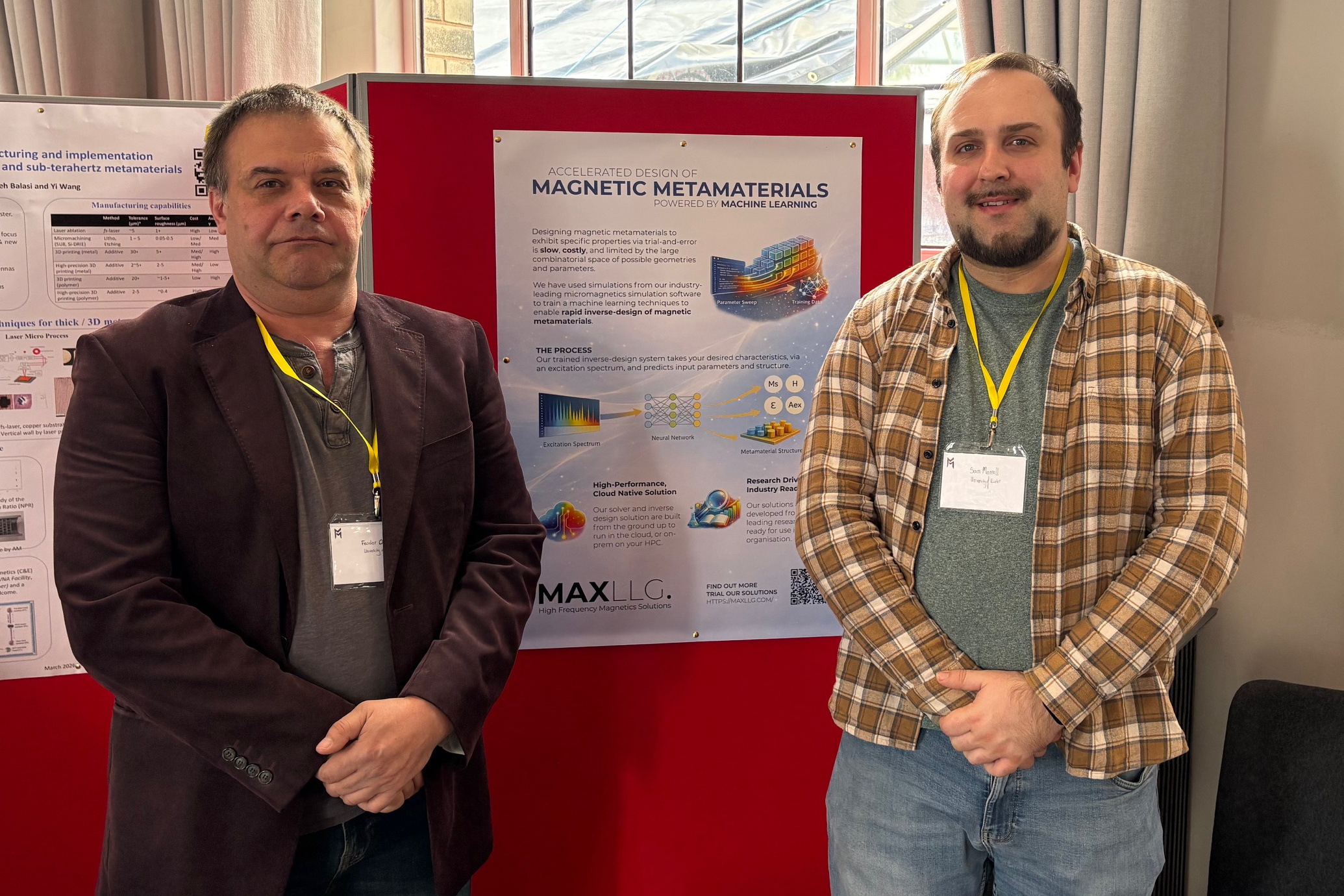
More broadly, the conference reinforced for us why MaxLLG exists. Born from EPSRC-supported research at the University of Exeter’s Centre for Metamaterial Research and Innovation, we are a company built at exactly the interface the conference was convened to address: between research excellence and the hard, practical work of making metamaterials real. We left Birmingham with new connections, sharper thinking, and a renewed sense of the momentum building in this field.
If you are working on metamaterials manufacturing and want to discuss how MaxLLG’s simulation and new inverse design platform could support your workflow, we would be delighted to hear from you.
The 1st Metamaterials Manufacturing Conference was organised by the Manufacturing Challenge team within the UK Metamaterials Network, and held at The Exchange, Birmingham, 23–24 March 2026.