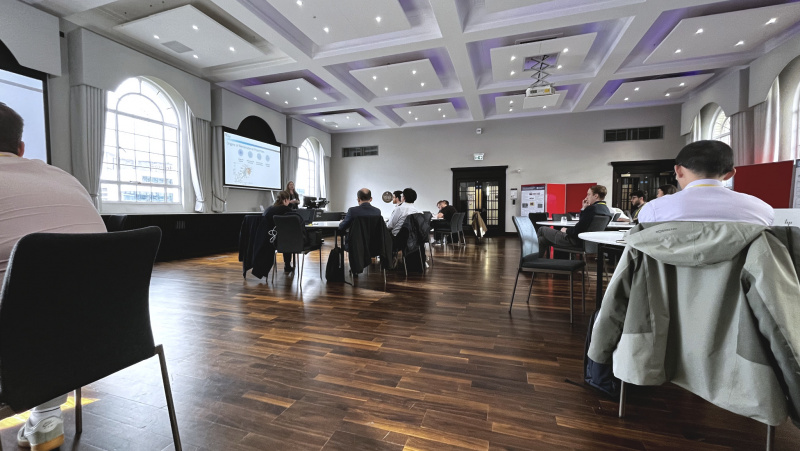

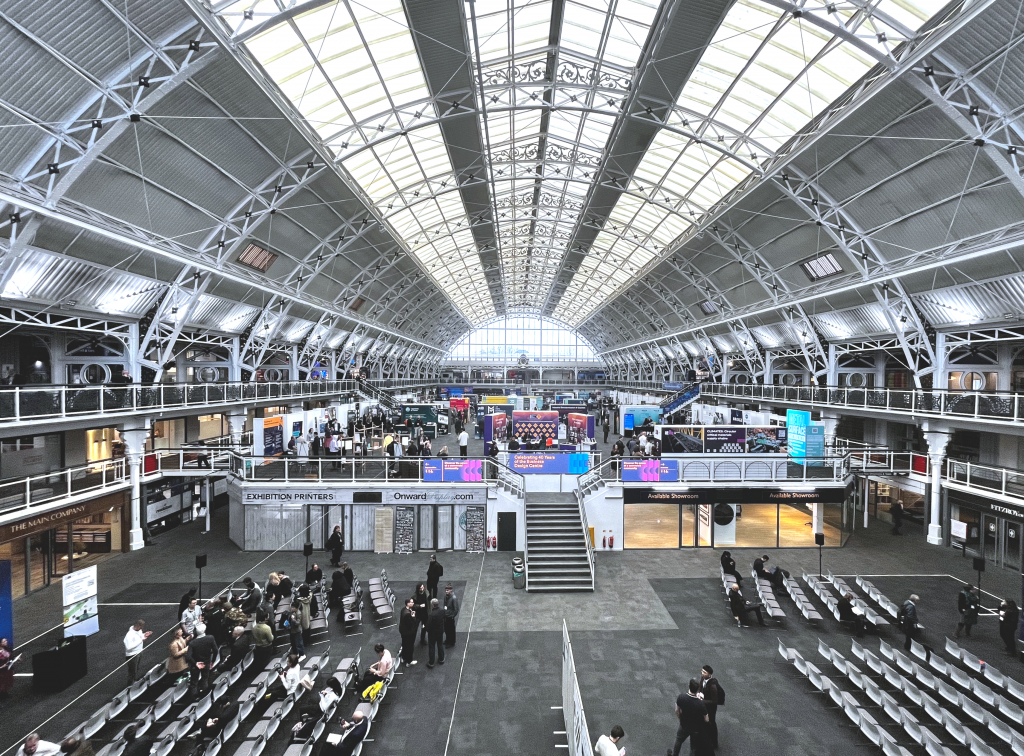
The Materials Research Exchange 2026 (MRE2026), organised by Innovate UK under its theme of Advanced Materials for the Future, brought together the UK’s most dynamic community of materials researchers, innovators, investors, and industry end-users over three days at the Business Design Centre in London. For the MaxLLG team, attending this flagship national event was both an opportunity to share our work and a vivid reminder of just how central magnetic metamaterials are becoming to the UK’s strategic materials agenda.
What Are Magnetic Metamaterials — and Why Do They Matter?
For the uninitiated, explaining metamaterials at a conference full of specialists from across the entire materials spectrum — from textiles and renewables to aerospace composites — was a rewarding exercise in itself. The UK Metamaterials Network‘s community-agreed definition frames it well: a metamaterial is a three-dimensional structure whose response or function arises from the collective effect of engineered “meta-atom” elements (analagous to a unit cell in a lattice structure), producing behaviours impossible to achieve with any individual constituent material on its own.
Magnetic metamaterials take this further. By combining carefully architected structures with magnetically active materials — such as ferromagnets or ferrimagnets — at the sub-wavelength scale, it becomes possible to engineer electromagnetic responses in the radio-frequency, microwave, and millimetre-wave bands that simply do not exist in nature. The resonance properties of the magnetic constituent enhance responses across a broad frequency range and introduce two particularly valuable features: tunability, meaning the material’s behaviour can be adjusted dynamically, typically with an applied magnetic field, and non-reciprocity, where electromagnetic waves behave differently depending on the direction of travel. These are not incremental improvements on existing materials — they represent a qualitatively different design space for engineers working on 5G and beyond-5G communications, radar, satellite systems, and defence electronics.
The key technical challenge — and the gap that MaxLLG was founded to address — is that no commercially available electromagnetic wave simulator has historically been capable of correctly accounting for magnetic phenomena in the RF and microwave frequency range. Standard numerical methods require enormous approximation when applied to magnetic metamaterials, leading to incorrect or misleading simulation results. MaxLLG’s solver couples Maxwell’s equations with the Landau–Lifshitz–Gilbert (LLG) equation simultaneously and with high precision, obtaining the correct solution naturally. Our cloud-ready, high-performance platform enables design teams in telecommunications, aerospace, and defence to simulate, analyse, and optimise these structures without the costly, slow cycles of physical trial and error.
Conversations on the Exhibition Floor
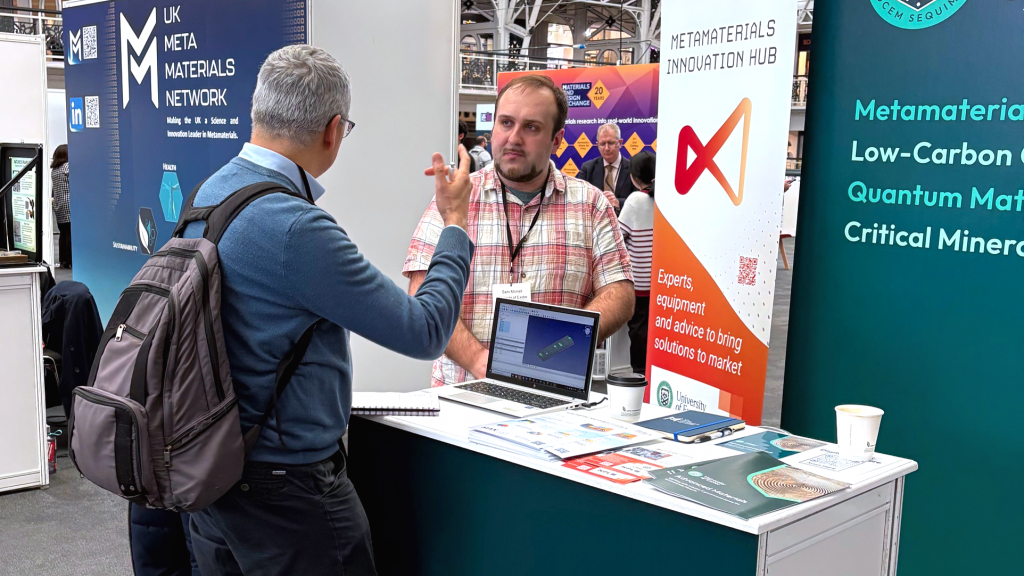
One of the most valuable aspects of MRE2026 was the sustained, informal contact with a wide range of attendees — from early-career university researchers to procurement leads at major manufacturers. Our team found ourselves explaining magnetic metamaterials repeatedly throughout the three days, and it became clear that the concept lands differently depending on the audience.
For researchers already working in photonics or microwave engineering, the magnetic dimension is intuitively interesting — they grasp quickly why tunability and non-reciprocity are transformative. For manufacturing and defence engineers, the most compelling angle is commercial and operational: the prospect of components that are lighter, smaller, and frequency-agile compared to conventional designs, with simulation tools accurate enough to underpin certification and procurement decisions.
The analogy our team found most effective on the floor was this: conventional electromagnetic simulators are a bit like designing a bridge while ignoring how the steel behaves under stress — you can get approximate answers, but when you need precision, you need to model the physics properly. MaxLLG’s solver models the magnetics properly.
The team were also showcasing our new inverse design product, harnessing our solver and cutting-edge machine learning techniques to deliver inverse design of magnetic metamaterials. Given the required properties of the metamaterial, this process quickly infers the required material and structure order of magnitude faster than possible with traditional trail-and-error approaches. This really hit home on the show-floor, with attendees excited about the acceleration in their development timescales possible with this apprach.
These conversations are not incidental. Engaging directly with end users, understanding the problems they are trying to solve, and articulating the pathway from fundamental physics to deployable technology is precisely the kind of knowledge exchange that drives genuine research impact — the translation of academic insight into measurable benefit for the economy and for society.
Lord Patrick Vallance’s Keynote: A Policy Mandate for Advanced Materials
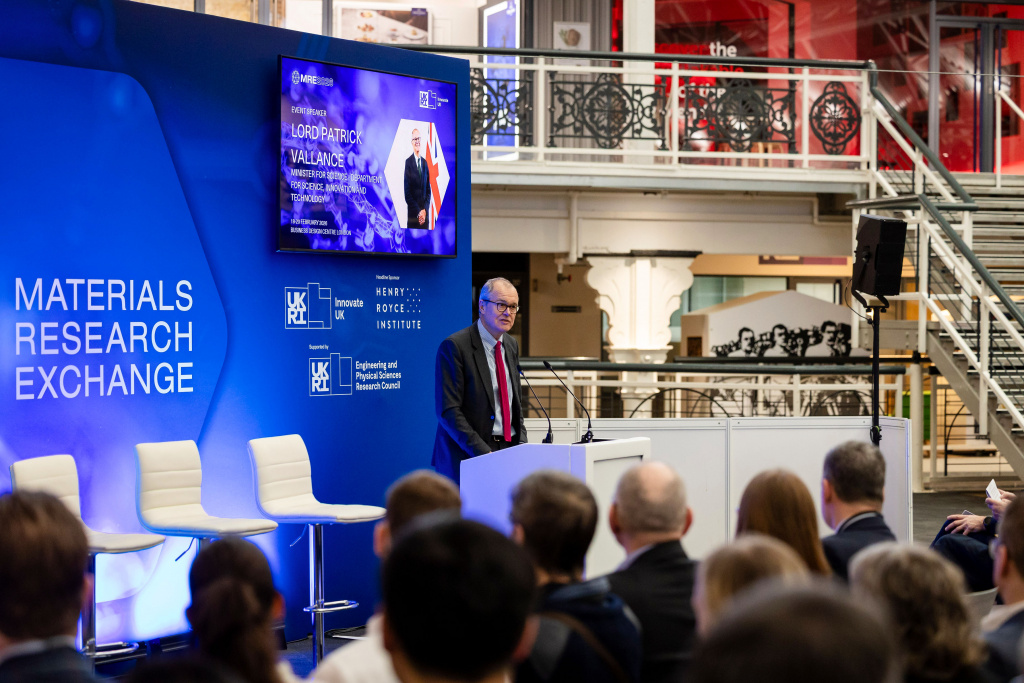
The conference was opened with a keynote address by Lord Patrick Vallance, Minister of State at the Department for Science, Innovation and Technology. Lord Vallance — who served previously as the Government’s Chief Scientific Adviser — brought both political authority and deep scientific literacy to his remarks, and his message was unambiguous: the UK’s ability to compete in strategic global industries depends critically on its capacity to develop, manufacture, and deploy advanced materials at scale.
Lord Vallance spoke to the importance of closing the gap between world-class university research and industrial adoption — a persistent challenge the UK has grappled with for decades. His framing resonated strongly with the MaxLLG story: a University of Exeter spin-out, born from EPSRC-supported research in the Centre for Metamaterial Research and Innovation, now providing industry-grade simulation tools that enable the commercialisation of metamaterials technology.
The ministerial endorsement of advanced materials as a national priority is significant not merely rhetorically. It signals continued government appetite for investment — through Innovate UK, EPSRC, and future industrial strategies — in exactly the technology areas where MaxLLG operates. For organisations seeking to build the evidence base for impact, this kind of high-level policy alignment matters: it situates our work within a recognised national need, with clear pathways from research excellence to economic and societal benefit.
The UK Metamaterials Network: A Community Coming of Age
MRE2026 also provided an important opportunity to connect with colleagues from across the UK Metamaterials Network (UKMMN), the EPSRC NetworkPlus based at the University of Exeter, which in 2024 received a £2.5 million investment to support the community through to 2028. The UKMMN has grown to over 1,000 members spanning academia, industry, and government agencies, and its presence at MRE2026 reflected how substantially the UK metamaterials community has matured.
MaxLLG’s roots in the University of Exeter and its ongoing engagement with the UKMMN mean we are closely embedded in this network — contributing to it as both technology provider and industry partner. The network’s mission to connect fundamental science with market-leading technology mirrors our own commercial and research ambitions, and the cross-sector conversations it facilitates — between, say, an antenna designer at a defence contractor and a physicist working on active metamaterial structures — are precisely the kind of interactions that generate the next generation of application opportunities.
The network’s influence on the broader MRE2026 programme was evident throughout. Metamaterials featured as a cross-cutting theme across multiple sessions, reflecting its unique position as a design paradigm that is relevant to electromagnetic, acoustic, mechanical, and thermal applications alike. For attendees unfamiliar with the field, the breadth of potential application — from stealth and sensing in defence to miniaturised antennas in mobile devices, to soundproofing in urban infrastructure — was frequently a revelation.
Looking Ahead
Attending MRE2026 reinforced for us that the UK’s advanced materials ecosystem is at an inflection point. The policy environment is supportive, the research base is world-leading, and the industrial appetite for novel materials solutions — particularly in communications, aerospace, and defence — is growing rapidly. Market analyses project the global metamaterials device market to exceed $14.5 billion by 2032, and the UK is well-positioned to capture a significant share of that growth.
MaxLLG’s role in this landscape is to provide the computational infrastructure that makes magnetic metamaterial design practical at an industrial scale — enabling faster, cheaper, more accurate design cycles and accelerating the journey from laboratory concept to deployed technology. Events like MRE2026, which bring the full breadth of the UK materials community into dialogue, are essential to that process.
We look forward to continuing these conversations — in the exhibition hall, in the seminar room, and in the field.
MaxLLG is a University of Exeter spin-out providing high-performance electromagnetic simulation software for magnetic materials and metamaterial systems. To learn more about our technology or to request a free trial, visit maxllg.com.